Birding from the Andes to the Amazon (10 Days)
Birding from the Andes to the Amazon (10 Days)
Duration
10 days
Start/End
Cusco/Puerto Maldonado
Tour type
Private · Group
Level
Moderate
Overview
On this ten-day expedition you experience Peru's most species-rich habitats on one trip: from the high valleys and puna around Cusco through elfin forest and cloud forest down to the Amazon lowlands at the famous Manu Wildlife Center. Along the way you will meet numerous endemics, colorful tanagers and hummingbirds, as well as the great wildlife spectacles of the rainforest. Highlights include the Huacarpay wetlands, the Andean Cock-of-the-rock lek, the bamboo forests of Villa Carmen, the macaw clay lick and the tapir clay lick at the Manu Wildlife Center, and an oxbow lake with giant otters. With a little luck you will also see spectacled bear, Andean fox and several species of monkeys. Private transport on the Manu Road, covered motorized canoes, birding guide, 9 nights in lodges, all meals as per itinerary and all national park permits are included. The tour ends in Puerto Maldonado.
Tour Code
Maximum altitude
Travel Program
Day 1
Cusco – Huacarpay Wetlands – Acjanaco Pass – Wayqecha
Wayqecha Research Station
Wetland, dry scrub, puna and elfin forest
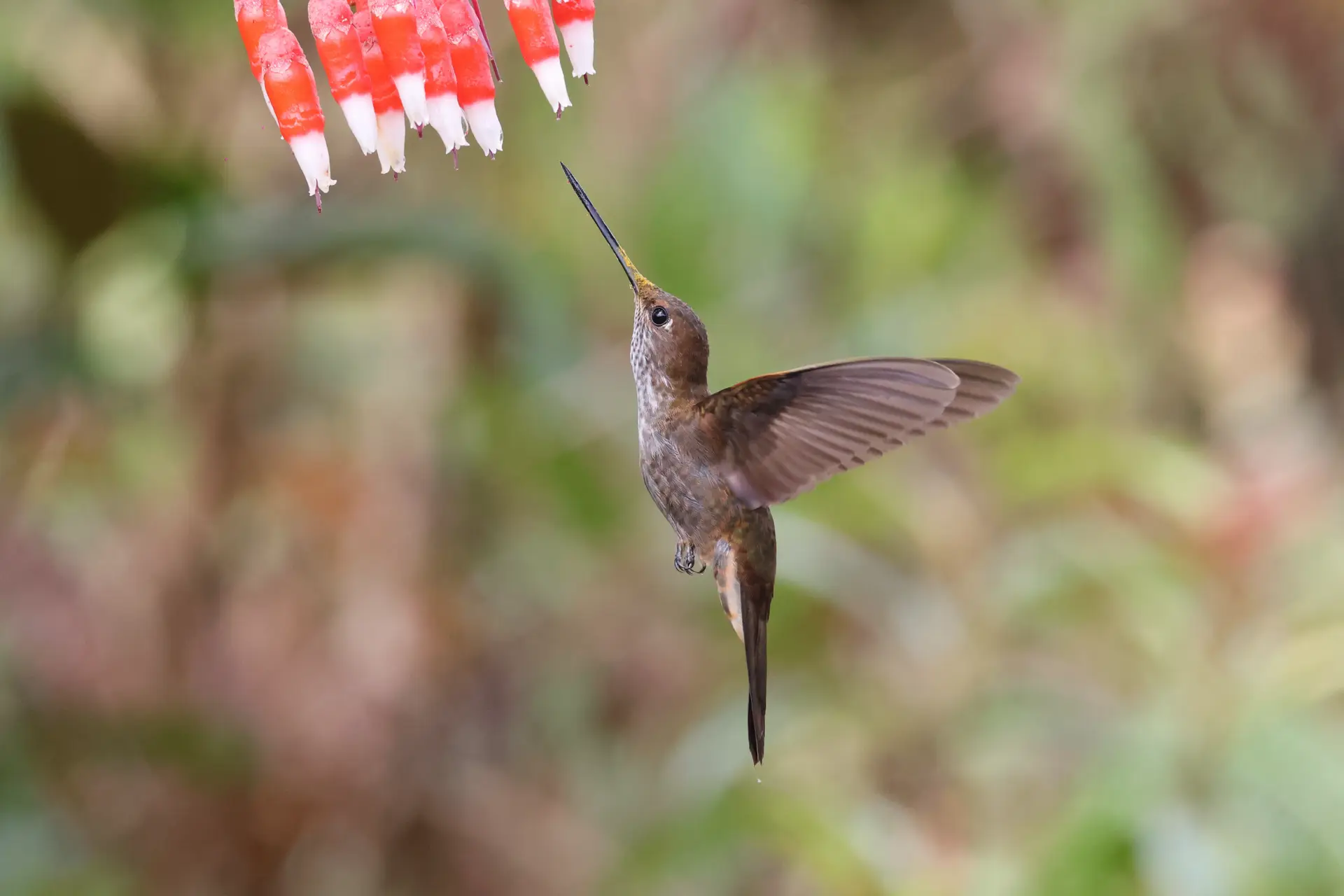
Early in the morning we drive from Cusco to the Huacarpay wetlands. In the reeds and on the water we look for Yellow-billed Pintail, Puna Teal, Plumbeous Rail, Andean Duck, Andean Tinamou, White-tufted Grebe, Many-colored Rush Tyrant and Wren-like Rushbird. Flowering tobacco attracts hummingbirds such as Giant Hummingbird, Black-tailed Trainbearer and the endemic Bearded Mountaineer; the dry scrub is home to Rusty-fronted Canastero and the rare Darwin's Nothura. Crossing the puna, we climb to the Acjanaco Pass, the gateway to Manu National Park, where we have a picnic. In the elfin forest we search for Urubamba and Red-and-white Antpitta, Puna Thistletail and Grass-green Tanager. In the evening we reach Wayqecha; optionally we go owling for Yungas Pygmy-Owl and Swallow-tailed Nightjar.
Cusco – Huacarpay Wetlands – Acjanaco Pass – Wayqecha
Day 1
Wayqecha Research Station
Wetland, dry scrub, puna and elfin forest
Early in the morning we drive from Cusco to the Huacarpay wetlands. In the reeds and on the water we look for Yellow-billed Pintail, Puna Teal, Plumbeous Rail, Andean Duck, Andean Tinamou, White-tufted Grebe, Many-colored Rush Tyrant and Wren-like Rushbird. Flowering tobacco attracts hummingbirds such as Giant Hummingbird, Black-tailed Trainbearer and the endemic Bearded Mountaineer; the dry scrub is home to Rusty-fronted Canastero and the rare Darwin's Nothura. Crossing the puna, we climb to the Acjanaco Pass, the gateway to Manu National Park, where we have a picnic. In the elfin forest we search for Urubamba and Red-and-white Antpitta, Puna Thistletail and Grass-green Tanager. In the evening we reach Wayqecha; optionally we go owling for Yungas Pygmy-Owl and Swallow-tailed Nightjar.
Day 2
Wayqecha – Elfin Forest
Wayqecha Research Station
Full day of birding in gardens, on trails and on the canopy walkway (approx. 3,000 m)
All day we explore the station's gardens, trails and canopy walkway amid mist-shrouded, orchid-laden dwarf trees. Target species include Long-tailed Sylph, Scaled and Shining Metaltail, Amethyst-throated Sunangel, Collared Inca, Hooded Tinamou, Stripe-faced Wood-Quail, Black-and-chestnut Eagle, Crimson-mantled Woodpecker, Inca Flycatcher, Golden-headed Quetzal and mixed tanager flocks. Along the forest edges we keep an eye out for spectacled bear and Andean fox.
Wayqecha – Elfin Forest
Day 2
Wayqecha Research Station
Full day of birding in gardens, on trails and on the canopy walkway (approx. 3,000 m)
All day we explore the station's gardens, trails and canopy walkway amid mist-shrouded, orchid-laden dwarf trees. Target species include Long-tailed Sylph, Scaled and Shining Metaltail, Amethyst-throated Sunangel, Collared Inca, Hooded Tinamou, Stripe-faced Wood-Quail, Black-and-chestnut Eagle, Crimson-mantled Woodpecker, Inca Flycatcher, Golden-headed Quetzal and mixed tanager flocks. Along the forest edges we keep an eye out for spectacled bear and Andean fox.
Day 3
Wayqecha – Manu Road – Cock-of-the-Rock Lodge
Cock-of-the-Rock Lodge
Descent into the cloud forest · Lek in the afternoon
Early in the morning we look around Wayqecha for Gray-breasted Mountain-Toucan, Marcapata Spinetail and Rufous-capped Thornbill. Then we drive down the Manu Road, stopping for mixed flocks, quetzals, trogons, Blue-banded Toucanet, Handsome Flycatcher and the elusive Andean Potoo. In the late afternoon we reach the Cock-of-the-Rock Lodge and visit the observation platform at the lek, where the Andean Cock-of-the-rocks perform their loud, fascinating courtship display.
Wayqecha – Manu Road – Cock-of-the-Rock Lodge
Day 3
Cock-of-the-Rock Lodge
Descent into the cloud forest · Lek in the afternoon
Early in the morning we look around Wayqecha for Gray-breasted Mountain-Toucan, Marcapata Spinetail and Rufous-capped Thornbill. Then we drive down the Manu Road, stopping for mixed flocks, quetzals, trogons, Blue-banded Toucanet, Handsome Flycatcher and the elusive Andean Potoo. In the late afternoon we reach the Cock-of-the-Rock Lodge and visit the observation platform at the lek, where the Andean Cock-of-the-rocks perform their loud, fascinating courtship display.
Day 4
Cloud Forest around the Cock-of-the-Rock Lodge
Cock-of-the-Rock Lodge
Full day of birding on the Manu Road · Night walk
All day, at a relaxed pace along the Manu Road, we watch huge mixed flocks with Golden-eared, Golden-naped, Orange-eared, Paradise, Golden and Saffron-crowned Tanager. In the dense foliage we look for Crested and Golden-headed Quetzal, Amazonian Umbrellabird, Solitary Eagle and Versicolored Barbet, while woolly monkeys and capuchins move through the canopy. At night we search for Lyre-tailed Nightjar, Band-bellied Owl and Rufescent Screech-Owl.
Cloud Forest around the Cock-of-the-Rock Lodge
Day 4
Cock-of-the-Rock Lodge
Full day of birding on the Manu Road · Night walk
All day, at a relaxed pace along the Manu Road, we watch huge mixed flocks with Golden-eared, Golden-naped, Orange-eared, Paradise, Golden and Saffron-crowned Tanager. In the dense foliage we look for Crested and Golden-headed Quetzal, Amazonian Umbrellabird, Solitary Eagle and Versicolored Barbet, while woolly monkeys and capuchins move through the canopy. At night we search for Lyre-tailed Nightjar, Band-bellied Owl and Rufescent Screech-Owl.
Day 5
Cock-of-the-Rock Lodge – Kosñipata Valley – Villa Carmen
Villa Carmen Biolodge
Hummingbird feeders and endemics of the foothills
In the morning we watch hummingbirds in the lodge garden such as Many-spotted Hummingbird, Violet-fronted Brilliant, Booted Racket-tail, Wire-crested Thorntail and Buff-tailed Sicklebill. In the Kosñipata Valley we look for Black-backed Tody-Flycatcher, Blue-capped Manakin and Peruvian Piedtail. In the afternoon we reach the Villa Carmen Biolodge. At the hummingbird and fruit feeders you can photograph Rufous-crested Coquette, Black-eared Fairy, Gould's Jewelfront, Lemon-throated Barbet, Turquoise Tanager and Great Potoo. In the evening we search for Striped Owl, Band-bellied Owl and Spectacled Owl.
Cock-of-the-Rock Lodge – Kosñipata Valley – Villa Carmen
Day 5
Villa Carmen Biolodge
Hummingbird feeders and endemics of the foothills
In the morning we watch hummingbirds in the lodge garden such as Many-spotted Hummingbird, Violet-fronted Brilliant, Booted Racket-tail, Wire-crested Thorntail and Buff-tailed Sicklebill. In the Kosñipata Valley we look for Black-backed Tody-Flycatcher, Blue-capped Manakin and Peruvian Piedtail. In the afternoon we reach the Villa Carmen Biolodge. At the hummingbird and fruit feeders you can photograph Rufous-crested Coquette, Black-eared Fairy, Gould's Jewelfront, Lemon-throated Barbet, Turquoise Tanager and Great Potoo. In the evening we search for Striped Owl, Band-bellied Owl and Spectacled Owl.
Day 6
Villa Carmen – Bamboo Forest and Machuwasi Oxbow Lake
Villa Carmen Biolodge
Bamboo specialists · Wooden catamaran ride
In the morning we focus on the bamboo forests of Villa Carmen with specialists such as Rufous-headed Woodpecker, Rufous-vented Ground-Cuckoo, Bamboo Foliage-gleaner, Manu and Goeldi's Antbird, Bamboo Antshrike, Red-billed Scythebill, Fine-barred Piculet and Scarlet-hooded Barbet. In the afternoon we take wooden catamarans across the Machuwasi oxbow lake for Hoatzin, Black-and-white Crake, Grey-necked Wood-Rail, Ladder-tailed Nightjar and White-eyed Blackbird. At a feeder White-necked Jacobin, Koepcke's Hermit and Amazonian Antpitta show up; plus squirrel and howler monkeys.
Villa Carmen – Bamboo Forest and Machuwasi Oxbow Lake
Day 6
Villa Carmen Biolodge
Bamboo specialists · Wooden catamaran ride
In the morning we focus on the bamboo forests of Villa Carmen with specialists such as Rufous-headed Woodpecker, Rufous-vented Ground-Cuckoo, Bamboo Foliage-gleaner, Manu and Goeldi's Antbird, Bamboo Antshrike, Red-billed Scythebill, Fine-barred Piculet and Scarlet-hooded Barbet. In the afternoon we take wooden catamarans across the Machuwasi oxbow lake for Hoatzin, Black-and-white Crake, Grey-necked Wood-Rail, Ladder-tailed Nightjar and White-eyed Blackbird. At a feeder White-necked Jacobin, Koepcke's Hermit and Amazonian Antpitta show up; plus squirrel and howler monkeys.
Day 7
Villa Carmen – Atalaya – Boat Ride to the Manu Wildlife Center
Manu Wildlife Center
Boat ride on the Alto Madre de Dios · Observation tower
Drive to Atalaya and boat ride of several hours
In the morning we drive to the port of Atalaya at the confluence of the Piñipiñi and Alto Madre de Dios rivers and board large, covered motorized canoes. Heading downstream past the last Andean foothills and the village of Boca Manu, we see terns, cormorants, White-winged Swallows, Anhingas, Pied Lapwings and herons. In the afternoon we reach the Manu Wildlife Center and climb the 34-meter observation tower. From the top we overlook the canopy with mixed flocks, Spangled Cotinga, Yellow-ridged Toucan, Curl-crested Aracari, Grey-headed Kite, Red-throated Caracara and macaws flying past.
Villa Carmen – Atalaya – Boat Ride to the Manu Wildlife Center
Day 7
Manu Wildlife Center
Boat ride on the Alto Madre de Dios · Observation tower
Drive to Atalaya and boat ride of several hours
In the morning we drive to the port of Atalaya at the confluence of the Piñipiñi and Alto Madre de Dios rivers and board large, covered motorized canoes. Heading downstream past the last Andean foothills and the village of Boca Manu, we see terns, cormorants, White-winged Swallows, Anhingas, Pied Lapwings and herons. In the afternoon we reach the Manu Wildlife Center and climb the 34-meter observation tower. From the top we overlook the canopy with mixed flocks, Spangled Cotinga, Yellow-ridged Toucan, Curl-crested Aracari, Grey-headed Kite, Red-throated Caracara and macaws flying past.
Day 8
Manu Wildlife Center – Macaw Clay Lick
Manu Wildlife Center
Viewing from the hide at the clay lick · Rainforest trails
Early in the morning we take the boat and walk 35 minutes through palm swamps to the macaw clay lick. From a spacious hide we watch, over breakfast, Red-and-green Macaws, Blue-headed Parrots, Orange-winged Parrots and Yellow-crowned Parrots eating the mineral-rich clay (most active from August to October). In the afternoon we explore the trail network through terra firme forest, várzea and bamboo. Target species: Razor-billed Curassow, Pavonine Quetzal, Great Jacamar, Gould's Toucanet, Blue-backed Manakin, Royal Flycatcher and Rufous-fronted Antthrush. In the evening we go owling in the rainforest.
Manu Wildlife Center – Macaw Clay Lick
Day 8
Manu Wildlife Center
Viewing from the hide at the clay lick · Rainforest trails
Early in the morning we take the boat and walk 35 minutes through palm swamps to the macaw clay lick. From a spacious hide we watch, over breakfast, Red-and-green Macaws, Blue-headed Parrots, Orange-winged Parrots and Yellow-crowned Parrots eating the mineral-rich clay (most active from August to October). In the afternoon we explore the trail network through terra firme forest, várzea and bamboo. Target species: Razor-billed Curassow, Pavonine Quetzal, Great Jacamar, Gould's Toucanet, Blue-backed Manakin, Royal Flycatcher and Rufous-fronted Antthrush. In the evening we go owling in the rainforest.
Day 9
Manu Wildlife Center – Oxbow Lake and Tapir Clay Lick
Manu Wildlife Center
Catamaran ride on the oxbow lake · Evening at the tapir clay lick
In the morning we take a catamaran across an old oxbow lake, where a family of giant otters can be seen fishing, as well as Sungrebes, jacanas, Ospreys and resting macaws and toucans. In the afternoon a quiet trail leads us to the famous tapir clay lick. The raised platform is equipped with cushioned walkways, mattresses and mosquito nets. At dusk wild lowland tapirs weighing up to 270 kg come very close to the clay wall – flash photography is allowed here.
Manu Wildlife Center – Oxbow Lake and Tapir Clay Lick
Day 9
Manu Wildlife Center
Catamaran ride on the oxbow lake · Evening at the tapir clay lick
In the morning we take a catamaran across an old oxbow lake, where a family of giant otters can be seen fishing, as well as Sungrebes, jacanas, Ospreys and resting macaws and toucans. In the afternoon a quiet trail leads us to the famous tapir clay lick. The raised platform is equipped with cushioned walkways, mattresses and mosquito nets. At dusk wild lowland tapirs weighing up to 270 kg come very close to the clay wall – flash photography is allowed here.
Day 10
Manu Wildlife Center – Puerto Maldonado
Upstream boat ride and transfer
Boat ride and van transfer to Puerto Maldonado
After a last breakfast at the lodge we travel upstream by boat and then by van to Puerto Maldonado. From there you take a scheduled flight to Cusco or Lima.
Manu Wildlife Center – Puerto Maldonado
Day 10
Upstream boat ride and transfer
Boat ride and van transfer to Puerto Maldonado
After a last breakfast at the lodge we travel upstream by boat and then by van to Puerto Maldonado. From there you take a scheduled flight to Cusco or Lima.
Price from
US$4,320.00
Services
What's included
Pre-trip briefing: Personal briefing with your guide at your hotel in Cusco two days before departure.
Birding guide: Experienced Peruvian birding guide, bilingual (Spanish and English), with in-depth knowledge of bird calls and ecology.
Transport: Private minivan on the Manu Road and safe, covered motorized canoes on the rivers.
Accommodation: 9 nights at the Wayqecha Research Station, Cock-of-the-Rock Lodge, Villa Carmen Biolodge and Manu Wildlife Center, in private rooms with mosquito net and private bathroom.
Meals: 9 breakfasts, 9 lunches and 9 dinners with fresh regional ingredients; vegetarian, gluten-free or lactose-free on request.
Permits: All official entrance and conservation fees for Manu National Park.
What's not included
Flights: Flight from Puerto Maldonado to Cusco or Lima as well as international flights.
Insurance: Travel insurance covering medical emergencies, repatriation and trip interruption is mandatory.
Tips & personal expenses: Tips for guides, boatmen and lodge staff, personal expenses, souvenirs and alcoholic drinks.
Breakfast on day 1: Not included due to the early departure from Cusco.
Character of the trip
Condition
Moderate
Altitude
Moderate (up to 3,500 m)
Culture / nature
Balanced
Fitness – moderate: Walks on established forest trails, sometimes uneven or muddy, plus getting in and out of the river boats. The altitude drops day by day, so your body adjusts gradually.
Altitude – moderate: From Cusco and the Acjanaco Pass (approx. 3,500 m) we descend through elfin forest and cloud forest down to the Amazon lowlands at the Manu Wildlife Center.
Culture / Nature – nature-focused: Endemics, Andean Cock-of-the-rock, macaw and tapir clay licks, giant otters and monkeys – Peru's most species-rich habitats on one trip.
Lodges: 9 nights at the Wayqecha Research Station, Cock-of-the-Rock Lodge, Villa Carmen Biolodge and Manu Wildlife Center.
Dates and Prices
Individual Dates
Optional
Cusco City Tour (half day)
Public tour – you can find the private tour under “Day Tours”.
US$20.00
per person
Sacred Valley Tour (full day)
Public tour – you can find the private tour under “Day Tours”.
US$25.00
per person
Groups of 5 or more: contact us for special rates and tailor-made options.
Travel Information
Good to know
Itinerary: The schedule may vary slightly to make the most of the best birding opportunities.
Best time to travel: The tour is worthwhile all year round. In the dry season (May to October) roads and trails are in better condition and there is less rain; the macaw clay lick is most active from August to October. In the rainy and breeding season (November to April) birds sing and display the most, and fruiting trees attract many tanagers, toucans and cotingas.
Fitness: Moderate. Birding is mostly done on gravel roads, forest trails and boardwalks as well as from the boat. The demanding parts are the early starts (4:30–5:30 am), changing weather from 5 °C at the pass to 30 °C in the lowlands, and long days in the field.
Health: The tour descends to the Amazon lowlands at around 300 m. Please consult your doctor before traveling about yellow fever vaccination and malaria prophylaxis.
Diet: The lodges cater for vegan, vegetarian, gluten-free and lactose-free diets as well as allergies – please let us know when booking.
Power and connectivity: The lodges run on solar power or generators; there is hardly any mobile reception or Wi-Fi.
Private tour: The tour is private; small-group departures are available on request.
Arrival and departure: The tour starts in Cusco and ends in Puerto Maldonado. From there you fly to Cusco or Lima (flight not included). The trip combines perfectly with the Inca Trail or a visit to Machu Picchu beforehand.
What to bring
Binoculars: Essential, waterproof 8x42 or 10x42.
Clothing: Lightweight, quick-drying clothing in muted colors (olive, beige, brown) – no bright colors such as white, red or yellow. A warm fleece or down jacket for the first three days in the highlands and breathable tropical clothing for the days in the lowlands.
Rain protection: High-quality rain jacket and poncho.
Footwear: Waterproof hiking boots plus breathable trail runners or rubber boots for muddy forest trails.
Headlamp: With red-light mode for the night walks.
Protection: Insect repellent (picaridin or DEET) and sun hat.
Camera: Telephoto lens of 300 mm or more, spare batteries and memory cards.
Original passport: For the checkpoints at the national park.